Monday, 29 April 2013

Maintaining Flavor with Long-Term Food Preservation— Japan's Advanced Freezing Technology


Small Ice Crystals—The Secret to Maintaining Flavor

Frozen food kept at temperatures below -18˚C can be preserved for years, as bacteria and mold cannot grow at such low temperatures. Freezing technology has enabled us to eat meat, fish and other foods imported from abroad, as well as ready-prepared frozen meals.


                                          Rapid-frozen tuna from a ship arrives at port (Photo: JTB Photo Communications, Inc.)                                                                  
However, there has been a downside to conventional freezing. Once food is frozen, it does not taste as good as freshly picked or freshly cooked food. The main reason is that when food is frozen, ice crystals inside the food expand, causing the cells to burst. When they burst, the nutrients turn to liquid (called "drip") and seep out as the food defrosts. The texture of the food also changes.

Tuna sushi—familiar to everyone now, thanks to progress in freezing technology (Photo: AFLO)

In an attempt to solve this problem, a method called "rapid freezing" was developed. When the water inside food freezes, ice crystals develop at temperatures between -1˚C and -5˚C. If this temperature range is passed through quickly (ideally within 30 minutes), most of the ice crystals do not grow too large, and the cells are not damaged. This process is the rapid freezing technique.

In Japan, rapid freezing technology was immediately put to use around 1960 on fishing boats to preserve tuna and other catches. The flavor of the rapid-frozen tuna also lasts much longer when preserved at a temperature below -50˚C. This has greatly helped to make Japanese dishes using raw fish—such as sashimi and sushi—popular around the world.

The Search for Freezing Technology That Doesn't Damage Cells

However, freezing technology was not perfect. Even when using rapid freezing, some cell damage still occurred—it was not possible to completely avoid changes in color or quality in foods that had been preserved at very low temperatures.

Then along came the development of "instant freezing." Water and food do not necessarily begin to freeze at 0˚C. If the water molecules or other substances that form the core of ice crystals are not present, then water and food do not begin to freeze even at -10˚C, a state known as "supercooling." When a supercooled liquid is agitated, everything freezes instantaneously. This is the process known as "instant freezing."

Left: Acerolas, so fresh you would not believe they were frozen. Right: Rice that has been frozen for 10 years shows no sign of cracking or yellowing. Both have been kept in a CAS freezer.
Left: Acerolas, so fresh you would not believe they were frozen.
Right: Rice that has been frozen for 10 years shows no sign of cracking or yellowing. Both have been kept in a CAS freezer.
With normal freezing methods, including rapid freezing, the food freezes from the outside to the inside. However, with instant freezing, the surface and the inside freeze at the same time. Therefore, the ice crystals freeze before they can clump together with other ice crystals to expand, so they remain small. This means that the cells are hardly damaged at all. Still, there remains an obstacle: the temperature range in which food supercools depends on the type of food and the specific part, so instant freezing cannot be used for every food.

In recent years, a groundbreaking instant freezing technology developed in Japan known as "Cells Alive System" (CAS) has been gaining attention as a method to address this problem. With CAS technology, the food is placed in a magnetic field that inverts repeatedly, so the food undergoes rapid freezing while being vibrated. According to scientists, the process of CAS freezing occurs instantaneously—just as with supercooling—with almost no time difference between the freezing of the surface and the inside. The ice crystals do not become too large, and the cells are hardly damaged, which means the original flavor, aroma, texture and color are maintained. In fact, fruit and vegetables that are difficult to freeze using conventional methods have been successfully preserved for long periods, maintaining their original fresh qualities. The mechanism behind CAS has not yet been fully clarified, but experts are considering various medical uses for the process, including the preservation of transplant organs and so forth.

From rapid freezing to instant freezing to CAS—nowadays, Japanese freezing technology is pushing the boundaries, making a substantial contribution to the improvement of the global food supply and the development of food culture across the globe.

Conventional freezing
(1) Water molecules in the material before freezing.
(2) Ice crystals near the surface expand before the whole item freezes, destroying the cell membrane as well as the nutrient and aroma elements inside the cell.
(3) Once defrosted, the phenomenon called "drip" occurs, meaning that the water, nutrient and aroma elements seep out of the cell.

CAS and other instant freezing
(1) Water molecules in the material before freezing.
(2) The materials all freeze instantaneously.
(3) After defrosting, the molecules return to their original state, and the material retains its freshness.

Defrost an oyster from a CAS freezer, and you can almost smell the seashore…it's really fresh!

(Updated in September 2011)

CAS freezers
CAS freezers made by ABI Inc., a Japanese company.

SPY CAMERA SUNGLASSES


If you know GFM you will know that we love spy gadgets that have practical uses. Yep we actually love them and these funky looking spy camera sun glasses are no exception. Hold up! A practical use for spy camera sunglasses? Honestly? Bear with us and all will be explained.
So lets start with the basics. They are essentially a pair of smart looking shades with 1GB of memory and a 1.3 mega-pixel covert camera built in. Our first thoughts were along the lines of; “How the hell are you going to be able to hide a 1.3 mega-pixel camera and all the rest of the electronics involved ‘covertly?
The glasses will be much bigger than usual and any numpty will easily be able to tell something is up!” – Yes, the arms of the shades are slightly oversized but not to the extent we were expecting.

They also have ear phones attached to each arm as the memory can act as an mp3 player. This is nothing new as Oakley did it years ago and music playing sunglasses are becoming ever more popular. And this is where the genius lies. When someone sees the larger than usual arms they may suspect something, but when they realise it is an mp3 player nearly all suspicion goes out of the window. The camera itself is surprisingly small and cleverly placed on the front right arm of the glasses.
In our opinion, if someone was to see the camera, they would have to have be stood that close you could have told them what they had for lunch by the remnants of it between their teeth. To take a photo you simply click a button, but not on the glasses (that would be hardly subtle).
The shades are supplied with a tiny RF remote that can easily be concealed about your person so you can snap away without anyone suspecting a thing. Because the camera captures photos in a 1280×1024 resolution you can store 10,000 pics on the 1GB of memory. That’s more photos stealthily taken on a pair of glasses than the average person takes in their entire life. We love it.
So we are back to the original claim of showing the spy camera sunglasses actually have a practical use. The first person to point one of these out was a friend of GFM who asked where he could get a pair to go cycling with. He said the mp3 player would hold enough tracks for a “mountain session” and the camera would be a nice addition to take photos of the views (we laughed and called him a girl).
You could also use these if your line of work requires, or is made easier by taking a lot of photos of whatever you are viewing e.g, private security, traffic wardens, doormen, government spys, stalkers etc… point proved? you decide.

ROVIO-ONLINE REMOTE CONTROLLED HOME SECURITY ROBOT


The Rovio is the perfect remote-controlled robot, featuring some pretty useful technology to make it a gadget you’ll get hours of fun from. Essentially, you control the robot by using a standard web browser, which can be on your PC, your laptop, your mobile phone or your games console.
The Rovio also includes a VGA camera and a microphone, allowing you to use it for a little spying around the home or office. And the best bit, when the Rovio’s batteries start to run low, it will automatically return to its docking station to charge itself up!
The Rovio robot connects to a standard Wifi router, allowing it to work without any wires whatsoever. When you first get the robot, you’ll need to configure it to talk to your wireless network by connecting it to your PC or Mac via a USB cable. However, setting up the robot only takes a few minutes. Once you’ve configured the Rovio, you’re up and running using the very simple software. The software works on all major web including Firefox, Safari and Internet Explorer.

Thanks to a 3-wheel system, the Rovio is very maneuverable. This wheel system allows you to move in the Rovio any direction you wish, whilst still keeping the camera and microphone pointed in one direction. For example, the Rovio can move sideways even whilst the camera is facing forwards. This is not something you typically get with a radio controlled car! The camera has a VGA camera, which gives you an image size of about 640 pixels by 480 pixels (width x height), which is perfect for navigating the Rovio around obstacles.
So as you drive the Rovio remote control security robot around the office or your home, you’ll see a live video feed of what’s in front of the Rovio. The camera is mounted on an arm which can be raised or lowered. You can change the height of the arm from ground level, to a height for looking over small objects, to a 45 degrees angle (ideal for looking at people standing up)


The Rovio makes use of a infrared location system, which allows the Rovio to determine where it’s located in a room. This means you can set up ‘checkpoints’ around a room. Once the Rovio knows about checkpoints, the robot can move between these checkpoints without you needing to manually control the robot to that part of the room. It’s almost like a programmed route. This is perfect for setting up the Rovio to do automated tours around an office or house. You can even set the Rovio up to capture images at predefined points on the route, and have it email those snapshots to you!
Thanks to the included microphone and camera, you can remotely observe your home in real time. If you want to talk to anyone around the robot, the Rovio also has a builtin speaker. So you just speak into your microphone on your computer, and it’s relayed to the robot over the internet and played on the speaker! And of course, if the batteries run low, the robot will automatically home in on the charging dock and recharge itself too!
So the Rovio remote controlled robot really is the ultimate in radio/remote controlled gadgets. You get a buggy that’s really easy to drive, plus an effective spy camera and microphone for realtime streaming, plus software that you can use anywhere in the world and the robot will keep itself fully charged. What more could you ask for?
This is a guest article by Dan Harrison who used to design Spy Gadgets for private detectives and the police. Now he spends his time researching and designing covert spy cameras.


Sunday, 28 April 2013

JAPANESE INVISIBLE TECHNOLOGY


Japanese Technology Makes Craziest Invisibility Cloak Yet (VIDEO)


Cloak

If you are one of the many children, okay, adults, still waiting for your Hogwarts acceptance letter, we have good news! This insane video shows Japanese technology that has actually managed to create an invisibility cloak, just like good old Harry's. They call it the 'transparent cloak' and it is pretty amazing.
The cloak is made using Retro-reflective Projection Technology, a process that superimposes the virtual world onto the real world. They call it creating an 'Augmented Reality.' (Creepy, right?) So actually, the cloak is not invisible per se, but rather made of lots of tiny beads that reflect light only in the direction they came from.
A camera in the cloak takes in the scene behind the wearer. Then, according to Creator's Project: "A computer processes the background imagery and relays it to a projector that filters through a half mirror and projects the scene onto the wearer. From a certain angle, the cloaked person looks transparent to onlookers."
The scientist behind it all, Dr. Susumu Tachi, is hoping to expand this technology to cover blindspots in cars, planes and helicopters. Personally, we are content with the cloak, but we understand that this has wider implications. While science has had a go at creating an invisibility cloak many times before, and have recently even created a time cloak, this technology seems to be a work of digital art. What do you think: art, science or both?


Japanese Technology Makes Craziest Invisibility Cloak Yet (VIDEO)

Cloak
First Posted: 01/09/12 07:26 PM ET Updated: 01/09/12 07:26 PM ET

VEGETABLES GROWN IN FACTORIES


Hi-tech


Hi-tech

Vegetables Grown in Factories


Key to Solving Food Shortage
 
The earth’s population, now seven billion, is said to exceed nine billion in 2050. Various problems need to be fixed to feed everyone. The conventional method of farming is influenced by weather, including hours of sunshine, temperature and rainfall. This method grows plants, which have their roots deep in the ground, while protecting them from diseases and insects, but it is difficult to assure a stable food supply. Under these circumstances, many factories where vegetables are grown indoors without using soil have been built in Japan. Fresh vegetables grown in these factories are being consumed in homes and restaurants. They have many advantages. One is that they are grown without using agricultural chemicals such as pesticide. The Japanese technology is attracting attention from overseas as well.

Inside of the vegetable factories in Japan

Year-round Vegetable Production Possible

 Vegetable factories are buildings in which they grow vegetables while artificially controlling the light, temperature, humidity and nutrients with computers. Some of them open their roofs to use natural sunlight, but what is attracting attention in Japan are those in which artificial lights, such as fluorescent lamps and light-emitting diodes (LEDs), are used instead of sunlight in a totally closed environment. Instead of soil, water in which nutrients are added is used to grow vegetables. As this method is not influenced by sunshine hours or temperature, it can grow plants all year round regardless of the season or location. Because vegetables are grown indoors, they are free from diseases, insects and weeds. So, a big advantage of this method is that it does not use agricultural chemicals and can produce vegetables safe to eat. Recently, studies are being made to grow more nutritious vegetables by, for example, controlling the wavelength of LED lighting.

 At present, it is said that there are more than 30 vegetable factories in Japan which grow plants using only artificial lighting. Plans to build such factories are spreading very rapidly to many parts of the country.
20,000 Heads of Lettuce per Day

One of the largest vegetable factories in Japan
One of the largest vegetable factories in Japan © Spread Co. Ltd.
 A leading vegetable factory in Japan is in Kameoka City, Kyoto. It is a four-story building, where four layers of shelves are built on each floor to grow lettuce. The total area of cultivation is 21,400 square meters. The factory ships about 20,000 heads of lettuce every day for sale at supermarkets and other stores. Since the building is four stories high, it can use the land very efficiently. Harvest per unit of space is 100 times greater than that of conventional ground farming.

 Sixty people are working in this plant. People who grow vegetables are all dressed in clean, white work clothes and wear masks and white caps. Before they enter the area where vegetables are grown, they thoroughly disinfect their hands with alcohol and take an air shower so they do not bring into the production area diseases, insects, viruses or bacteria that will harm the vegetables. These workers look entirely different from farmers who grow vegetables on the ground. As the temperature, humidity, sunshine hours and water with nutrients are all controlled with computers, the factory looks like a plant that makes precision machinery or medicines rather than a farm.

Taking an air shower before entering the area where vegetables are grownTaking an air shower before entering the area where vegetables are grown 
© Spread Co. Ltd.
A grower checking how lettuce is growingA grower checking how lettuce is growing
© Spread Co. Ltd.

Growing Vegetables in City Buildings

 There are vegetable factories in many places in Japan, but the most unique location is the Showa Base at the South Pole, which Japan has built for polar observation. Built in 2008, it is small, but grows lettuce, basil and other vegetables, using mostly fluorescent lamps as a source of light. As the South Pole is a harsh environment, where the temperature sometimes drops to almost minus 40 C, meals eaten by observation team members had tended to be mostly freeze-dried or retort-packed food. The vegetable factory has made them very happy because they can now eat fresh vegetables all year round.

社内に植物工場を持っている企業の本社ビル)
The headquarters building of a company in the center of Tokyo operating an in-house vegetable factory © Pasona Group Inc.


Vegetables grown in the hall on the first floor. Lighting is adjusted according to the speed of growth.
Vegetables grown in the hall on the first floor. Lighting is adjusted according to the speed of growth. 
© Pasona Group Inc.
 Meanwhile, there are companies growing vegetables in urban buildings. In a business district of Tokyo, a major company that dispatches temporary workers to businesses has built a vegetable factory in the company premises and supplies harvested vegetables to an employee cafeteria. Moreover, it grows lettuce and other vegetables on the first floor of the building and also in part of a conference room so visitors can see.

 In addition, it grows cucumbers on the ceiling above the reception area and tomatoes on the ceiling of a reception room. Once, the company grew rice as an experiment. It proves that it is possible to grow plants in urban buildings if the vegetable factory technology is used.

 Faced with an explosive population increase, many countries have to worry about their food supply. Against that background, vegetable factories in Japan receive an increasing number of visits and inquiries from overseas. The day appears near when Japan’s vegetable factory technology will contribute to solving the global problem of food shortage thanks to its advantages such as the absence of influence by the weather or environment and no soil pollution.

Vegetable-growing facility on the wall of a conference room. Harvested vegetables are supplied to an employee cafeteria.Vegetabl
VEGETABLE-growing facility on the wall of a conference room. Harvested vegetables are supplied to an employee cafeteria. © Pasona Group Inc.
Tomatoes are grown on the ceiling of a reception room.
Tomatoes are grown on the ceiling of a reception room. © Pasona Group Inc.


Saturday, 27 April 2013

Japan's Cutting-Edge Eco-Ships on Voyage


Hi-tech

Japan's Cutting-Edge Eco-Ships on Voyage


Everywhere you go in Japan, you see cars and home electronics products made to be friendlier to the global environment. And not just on land. By using the most advanced high technology in the world, Japanese companies are building ocean-going vessels called "eco-ships" which use less fuel and release less CO2 into the air. Japan is a shipbuilding superpower; one in every five ships made in the world is built in Japan. Building eco-ships is one of the ways in which Japan intends to contribute to preserving the global environment.

World's First Solar Power Ship

The Auriga Leader, a car carrier, which put solar energy into actual use for the first time in the world. © Nippon Yusen K.K.
Large cargo ships carry many things, including foods such as wheat and soybeans, liquefied natural gas (LNG), iron ore and cars. The largest car carrier made in Japan has 14 floors, is about 200 meters long, and can carry 6,400 cars on a single voyage.

 A giant ship like that needs a lot of fuel because it is heavy and because it faces great resistance from the waves. Eco-ships reduce CO2 emissions by using less fuel and reducing wave resistance.

 One way to do so is to use solar energy. The Auriga Leader, a Japanese car carrier which went into service in December 2008, is the world's first ship to put solar energy to actual use. The ship has 328 solar panels, spread over 250 square meters on the deck. Solar energy provides less than 1% of all the energy the ship uses. However, for the first time in the world, the Japanese ship also has large-volume batteries to store solar energy.                                                        


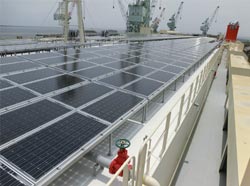
                                                   The Emerald Ace, a car carrier, with 768 solar panels installed on the deck


                                                                           A closer view of the solar panels aboard the Emerald Ace. © Mitsui O.S.K. Lines, Inc.
 In June 2012, the Emerald Ace, also a car carrier, went into service with 768 solar panels on its deck. This ship does not need fuel to generate electricity when in harbor. While out at sea, the ship generates electricity by solar energy and stores it in lithium-ion batteries on board. Once in harbor, its diesel generators are stopped and solar power is used. The onboard solar panels can generate about 160 kilowatts of electricity, enough to power about 50 homes. Ships just began to take advantage of solar energy and more solar ships are on the horizon.


Curbing Wave & Wind Resistance
The Yamato, a module carrier, uses air bubbles to decrease friction resistance with seawater. © NYK-Hinode Line, Ltd.
An artist's sketch of the Mitsubishi Air Lubrication system (MALS), showing air bubbles blown at the bottom of a ship. 
© Mitsubishi Heavy Industries, Ltd.

Eco-ships are also built to reduce the frictional resistance of waves and wind. In probably the most interesting way of doing so, some Japanese ships have a system for generating air bubbles at the bottom of the bow and sending them by a blower from bow to stern. The bubbles reduce frictional resistance between the ship and seawater, helping to propel the vessel. The bubble effect was known theoretically before, but it was Japan that actually built ships to take advantage of air bubbles for the first time in the world. Three bubble ships entered service since 2010, including the Yamato, a “module carrier” that transports modularized heavy and large loads. The ships have proven to reduce CO2 emissions by about 6%. It is a unique idea that a ship rides on air bubbles, isn't it?

Also, the City of St. Petersburg, a car carrier commissioned in December 2010, has a hemisphere-shaped bow. The rounded bow of the ship, which travels back and forth across the North Atlantic carrying a Japanese carmaker's vehicles, helps reduce wind resistance by up to 50%, slashing CO2 emissions by about 2,500 tons per year as a result.

The City of St. Petersburg, an energy-saving car carrier built by Kyokuyo Shipyard Corporation, which has a hemispherical bow to reduce wind resistance.

There is an ongoing plan to combine the two technologies – the hemispheric bow and solar panels on board – to build very fuel-efficient ships capable of curbing wind resistance and taking advantage of solar energy.

 In addition, Japan is recently experimenting with new methods for painting the ship hull. Inspired by Mother Nature, new sorts of surface painting, such as one likened to the skin of sharks moving swiftly through the water or to lotus leaves repelling water, are being developed with nanotechnology. Alloys such as aluminum as well as carbon fiber used for aircraft are also under consideration to reduce ship weight.

Dream Eco-Ship Planned

 There is a plan in Japan to build a "Super Eco-Ship" using both solar and wind power by 2030. The ship, 352 meters long, will have solar panels as well as eight large masts to take advantage of wind propulsion. It looks like a honeybee gliding on the water.

An artist’s sketch of the future container ship NYK Super Eco-Ship 2030.
An artist’s sketch of the future container ship NYK Super Eco-Ship 2030. © Nippon Yusen K.K.
 In additional to these natural energy sources, the ship is supposed to mainly use fuel-cell power derived from LNG. The ship will have a total of 16 modular fuel cells, each the size of a standard freight container, which can be replaced with new ones during a port call.

 In 2030, the dream eco-ship will be partially powered by LNG. Compared with current ships powered by diesel engines which burn heavy oil, the dream ship will cut CO2 emissions by 69%. Eventually, the ship will aim at zero waste emission.

 Ships all over the world are said to emit 1.05 billion tons of CO2 per year, accounting for 3.3% of total global CO2 emissions. That is more than the total amount of CO2 emitted by Germany per year. Now that emerging countries are developing rapidly, the world's ocean-going ships in 2050 will be emitting 2.5 times more CO2 than today, according to some experts. There is much hope in the world for Japan's eco-ship technologies to help preserve the global environment.